
This Week’s Sky at a Glance, 2025 Nov 29 – Dec 6
This Week’s Sky at a Glance, 2025 Nov 29 – Dec 6
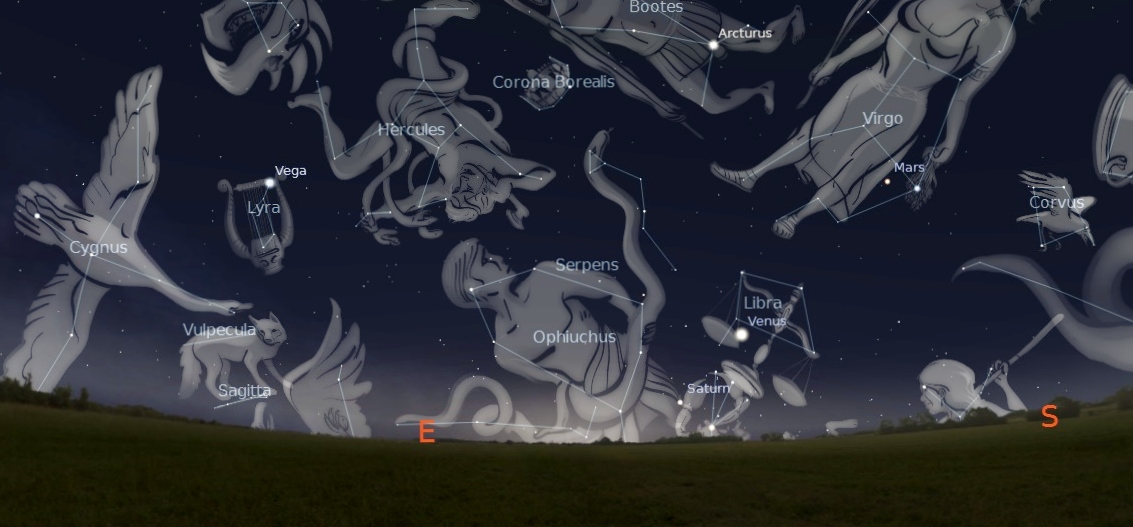
Soon many naturalists throughout the province will be busy performing Christmas bird counts. If you are on your toes and not too worn out you can add four stellar birds between dusk and dawn. Start with the easy ones around 6 pm by looking for the three bright stars of the Summer Triangle above the western horizon. The lowest of the three is Altair, the head of Aquila the Eagle, which is standing straight up on the horizon. The highest of the trio is Deneb at the tail of Cygnus the Swan, which is doing its signature dive. The third member is Lyra the Harp with its bright star Vega to the right of Altair. A few centuries ago celestial cartographers depicted the harp in the talons of an eagle or vulture, so maybe we can claim that as a fifth bird.
Midnight is your best chance to spot the elusive and tiny Columba the Dove, but you will need an unobstructed southern horizon. Look below Orion for Lepus the Hare, and then try to see stars near the horizon directly below. Very few bird counts will be missing the common crow but, in case you did, look about a hand span above the southern horizon around 6:30 am for a distinct quadrilateral of stars. There you will find Corvus the Crow hitching a ride on the tail of Hydra the Water Snake. You might also catch the swan and part of the eagle rising in morning twilight.
This Week in the Solar System
Saturday’s sunrise in Moncton is at 7:38 and sunset will occur at 4:36, giving 8 hours, 58 minutes of daylight (7:41 and 4:43 in Saint John). Next Saturday the Sun will rise at 7:46 and set at 4:33, giving 8 hours, 47 minutes of daylight (7:48 and 4:41 in Saint John).
The Moon is full just 12 hours after perigee on Thursday, giving extreme tides late in the week. Binocular or telescope users can watch it occulting some of the Pleiades late Wednesday evening. By midweek Mercury will be rising an hour and a half before sunrise and brightening as it nears greatest elongation next weekend. Venus trails it by 65 minutes but its brightness can cut through twilight for binocular users. Saturn will be at its best for observing around 7:15 pm, with Jupiter rising soon after. Next Friday telescope users can see Jupiter’s moon Io be eclipsed at 10:37 and Ganymede reappear from behind the other side two minutes later.
Tune in to the Sunday Night Astronomy Show at 8 pm on the YouTube channel and Facebook page of Astronomy by the Bay.