
This Week’s Sky at a Glance, 2025 Dec 6 – Dec 13
This Week’s Sky at a Glance, 2025 Dec 6 – Dec 13
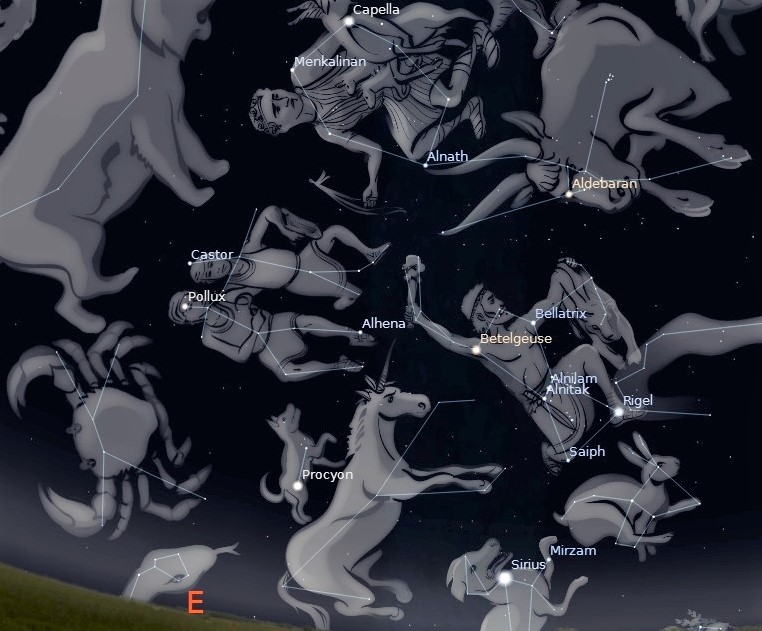
Having official constellations doesn’t prevent us from imagining our own. The sight of Orion, with club raised high and a lion-skin shield warding off the horns of a raging bull, has been etched in my memory for over 60 years. But come December, reddish Betelgeuse in Orion’s armpit becomes Santa’s red nose in profile, the curve of the shield outlines a sack of toys, and the iconic three-star belt is…well, Santa’s wide black leather belt. And on cold, clear nights there is no mistaking that twinkle in his eye. Look to the north and there is Santa’s sleigh, usually seen as the Big Dipper, being loaded up for the long night’s ride.
Many doors and windows are decorated with wreaths and the window of the winter sky is no exception. Here, Betelgeuse is a red light near the middle of a wreath we call the Winter Circlet or Winter Hexagon. By mid-evening you can trace the lights decorating the wreath, from blue-white Rigel in Orion’s leg to brilliantly colourful Sirius the Dog Star, up through Procyon the Little Dog Star, around Pollux and Castor in Gemini and Capella in Auriga to orange Aldebaran as the Bull’s eye, and back to Rigel. Imagination is a gift and Santa won’t mind if you open yours before Christmas.
This Week in the Solar System
Saturday’s sunrise is at 7:48 and sunset will occur at 4:41, giving 8 hours, 53 minutes of daylight. Next Saturday the Sun will rise at 7:55 and set at 4:41, giving 8 hours, 46 minutes of daylight.
The Moon is near Jupiter on Sunday, closely approaches Regulus late Tuesday evening, and it is at third quarter on Thursday. Mercury is at greatest elongation Sunday, rising around 6 am and standing ten degrees high toward the southeast an hour later. Venus is too close to the Sun for comfortable binocular viewing. Saturn is 40 degrees above the horizon around 7 pm this weekend, and Jupiter reaches that same altitude four hours later. Telescope users can see Jupiter’s moon Io reappear from behind the planet at 8:10 on Monday, and Ganymede disappear into Jupiter’s shadow at 8:00 on Friday. The highlight of the month occurs next weekend when the Geminid meteor shower peaks.
The Saint John Astronomy Club meets in the Rockwood Park Interpretation Centre this Saturday at 7 pm. The Fredericton Astronomy Club meets in the UNB Forestry-Earth Sciences building at 7 pm on Tuesday. Tune in to the Sunday Night Astronomy Show at 8 pm on the YouTube channel and Facebook page of Astronomy by the Bay.