
This Week’s Sky at a Glance, 2026 March 28 – April 4
This Week’s Sky at a Glance, 2026 March 28 – April 4
With Easter happening next weekend let us look for signs of it in the night sky. Lambs have long been associated with spring and Easter, so we can start with Aries the Ram low in the west. For many the symbol of Easter is Peter Cottontail, the Easter Bunny. When darkness sets in we can see Lepus the Hare below the feet of Orion. I see the constellation as three vertical pairs of stars, with the brightest pair in the middle and the widest to the right. With a reasonably dark sky you can see the bunny ears between the widest pair and Orion’s brightest star, Rigel.
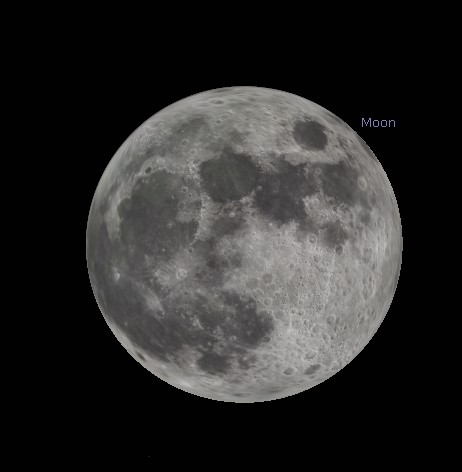
In Germanic mythology Ostara, the goddess of spring, found a wounded bird and changed it into a hare so that it could survive. This animal was allowed to run as fast as it could fly and it retained the ability to lay eggs, which it did in spring to honour its rescuer. The Saxon name for the goddess was Eostre. I think the best symbol is seen on the Moon when it is full or nearly so. When it rises in spring, look for the dark bunny ears to the upper right. With them identified, it isn’t difficult to picture Peter Cottontail clutching a giant egg.
This Week in the Solar System
Saturday’s sunrise is at 7:12 and sunset will occur at 7:47, giving 12 hours, 35 minutes of daylight. Next Saturday the Sun will rise at 6:58 and set at 7:56, giving 12 hours, 58 minutes of daylight.
The Moon is below Regulus on Sunday evening, full on Wednesday and near Spica Thursday. Venus sets around 9:30 pm this weekend, becoming more prominent now as it climbs up the steep angle of the spring ecliptic. Jupiter is high in the southwest at sunset, and this Saturday telescope users might see its moon Europa disappear behind the planet at 9:54. Mercury is a challenging binocular target, rising 50 minutes before sunrise this weekend but not gaining much altitude before twilight gets too bright. Saturn and Mars are too close to the Sun for observing. Beginning late in the week rural observers might see the subtle glow of zodiacal light in the west 60 to 90 minutes after sunset.
Tune in to the Sunday Night Astronomy Show at 8 pm on the YouTube channel and Facebook page of Astronomy by the Bay. The Saint John Astronomy Club meets in the Rockwood Park Interpretation Centre at 7 pm on April