
This Week’s Sky at a Glance, 2026 April 4 – April 11
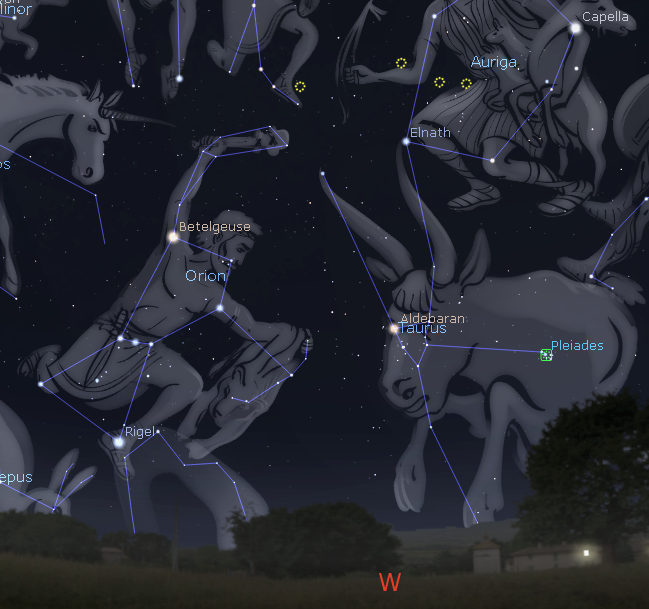
This Week’s Sky at a Glance, 2026 April 4 – April 11
In April we can start a long goodbye to the winter constellations. Orion and Taurus are setting together, which makes it easier to imagine their eternal battle. The bull is protecting the Pleiades (Seven Sisters) from the amorous advances of Orion, who is about to strike a downward blow to the bull’s head with his upraised club. The bull’s long horns, one tip of which is the bottom left star of Auriga (Elnath – officially the second brightest star of Taurus), are not to be taken lightly. It is difficult to tell which of the two combatants is more dangerous.
The winter constellations of Auriga and Gemini are still up past midnight but Rigel, in the knee of Orion and the low point of the Winter Circlet of bright stars, is setting around 11 pm. With the Pleiades sinking in the western twilight, through a thicker layer of our atmosphere, they will twinkle more. I have a pleasant memory of seeing them with binoculars when they were low in the west, flickering wildly like candles on a birthday cake. I had the urge to make a wish and blow them out. In a few weeks Venus will be beside the Pleiades, perhaps to cast a love spell on the sisters.
This Week in the Solar System
Saturday’s sunrise at 6:58 and sunset will occur at 7:56, giving 12 hours, 58 minutes of daylight. Next Saturday the Sun will rise at 6:46 and set at 8:05, giving 13 hours, 19 minutes of daylight.
The Moon is near Antares on Monday and it is at third quarter next Friday. Venus dominates the western sky in the evening, setting around 9:45 this weekend. This week telescope users can get an idea of how quickly its moon Io orbits. On Tuesday it begins to transit the face of Jupiter at 10:29 pm, followed by its shadow at 11:46, and the following evening it disappears behind the planet at 11:21. Still a challenging binocular target, Mercury brightens slightly over the week, rising about 45 minutes before sunrise this weekend and 40 minutes next weekend. Rural observers might see the subtle glow of zodiacal light in the west 60 to 90 minutes after sunset.
The Saint John Astronomy Club meets in the Rockwood Park Interpretation Centre at 7 pm on this Saturday. Tune in to the Sunday Night Astronomy Show at 8 pm on the YouTube channel and Facebook page of Astronomy by the Bay.