
This Week’s Sky at a Glance, 2026 April 18 – April 25
This Week’s Sky at a Glance, 2026 April 18 – April 25
When people see a telescope that doesn’t look like it came from a department store, they often ask how far you can see with it. The answer is difficult to explain and even more difficult to comprehend. Sometimes I just say “way far” and hope they don’t press for details.
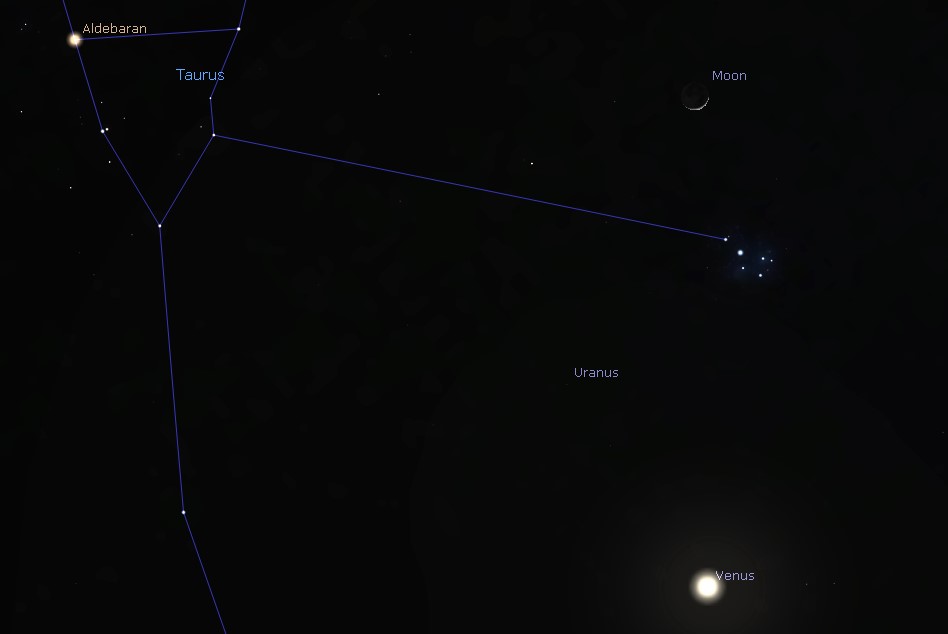
This weekend the brightest object in the evening sky is the Moon, near its closest at about 362,000 kilometres (km). The next brightest object is Venus, currently at 224 million km, while Uranus, possibly within a binocular view lower left of the Pleiades, is 3 billion km away. Light travels at 300,000 km per second, so at 150 million km the Sun is a distance of 500 light seconds away. The Moon is a tad more than one light second away, Venus is 12.4 light minutes, and Uranus nearly 3 light hours.
The brightest star we see in the evening now is still Sirius, the closest star we can see from New Brunswick at 8.6 light years (ly). The next brightest is Arcturus and it is 37 ly or 350 trillion kilometres. The Pleiades are about 440 ly away and Alnilam, the middle star of Orion’s belt, is 2000 light years. If you are under a dark sky well before morning twilight you might get a naked eye glimpse of the Andromeda Galaxy at a distance of 2.5 million light years. Binoculars will reveal galaxies even more distant, but at what point do these distances become incomprehensible and “way far” is a reasonable answer?
This Week in the Solar System
Saturday’s sunrise in Moncton is at 6:27 and sunset will occur at 8:10, giving 13 hours, 43 minutes of daylight (6:33 and 8:14 in Saint John). Next Saturday the Sun will rise at 6:15 and set at 8:19, giving 14 hours, 4 minutes of daylight (6:22 and 8:22 in Saint John).
The slim crescent Moon is to the right of Venus this Saturday, above the Pleiades on Sunday, near Jupiter Wednesday, and it reaches first quarter on Thursday. With next Saturday being the closest to the first quarter Moon after Easter it becomes International Astronomy Day, and Astronomy Week runs April 20-26. If you want to start the week with a tough binocular challenge, on Monday try to see Mars, Saturn and Mercury rising due east in a span of eight minutes about half an hour before sunrise. They form a line with dimmest Mars upper left and brightest Mercury lower right. Early Wednesday morning is the best time to catch some shooting stars of the Lyrid meteor shower emanating from a point overhead.
Tune in to the Sunday Night Astronomy Show at 8 pm on the YouTube channel and Facebook page of Astronomy by the Bay.