
This Week’s Sky at a Glance, 2026 August 8 – August 15
This Week’s Sky at a Glance, 2026 August 8 – August 15
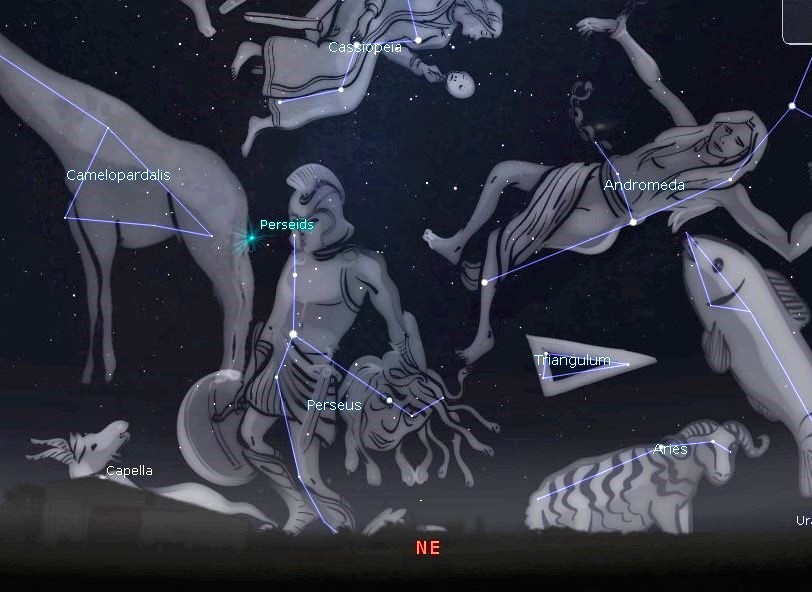
You can see a few meteors per hour on any night in a clear, dark sky, but the number increases greatly when Earth passes through a trail of pebbles and dust left by a comet that makes frequent orbits around the Sun. The pebbles left by comet Swift-Tuttle in its 133-year orbit are quite large at a few centimetres, and they enter our atmosphere at a high relative velocity of 60 km/s (Earth travels at 30 km/s). Therefore, they can be very bright. The Perseids will seem to be coming from a point between the constellations Perseus and Cassiopeia, which are highest in the sky in early morning. You will see fewer in the evening but they tend to be long and bright.
Meteors, also called shooting stars or falling stars, are the streaks of light created when pebbles enter the atmosphere at an altitude of about 100 kilometres, and those particles from comets disintegrate before they reach an altitude of 50 kilometres. Many meteors are faint and easily made invisible by moonlight and light pollution. This week the Perseid shower fortunately coincides with the new Moon. Get comfortable in a chair, have extra clothes or blankets if you plan to stay long as it can get very chilly, and select a patch of sky that is free of clouds and direct light. It is better to keep Perseus to your side rather than look in that direction because the meteors will look more spectacular, covering a longer distance. If the forecast is for clouds, the shower is often half as active the nights before and after.
This Week in the Solar System
Saturday’s sunrise in Saint John is at 6:17 and sunset will occur at 8:41, giving 14 hours, 24 minutes of daylight. Next Saturday the Sun will rise at 6:25 and set at 8:31, giving 14 hours, 6 minutes of daylight. There will be a partial eclipse of the Sun on Wednesday, starting just before 2 pm and lasting about two hours.
The crescent Moon is near Mars Sunday morning, less than half a binocular field above Mercury on Tuesday, and it is new on Wednesday. Venus reaches greatest elongation from the Sun next Saturday but most of that is horizontal distance due to the declining angle of the evening ecliptic. Saturn rises in the late evening, showing off the southern side of its rings for morning observers. Next Saturday Jupiter has a close conjunction with Mercury, rising 65 minutes before sunrise. The Perseid meteor shower peaks over Wednesday/Thursday with no moonlight to hide the fainter shooting stars.
There will be public observing of Wednesday’s partial solar eclipse from 1:30-4:00 pm at the Irving Nature Park in Saint John and Wilmot Park in Fredericton. Public observing continues in the Irving Nature Park that evening from 9-11 pm. The RASC NB star party takes place at Mount Carleton Provincial Park on August 14 and 15.