
This Week’s Sky at a Glance, 2026 Jan 17 – Jan 24
This Week’s Sky at a Glance, 2026 Jan 17 – Jan 24
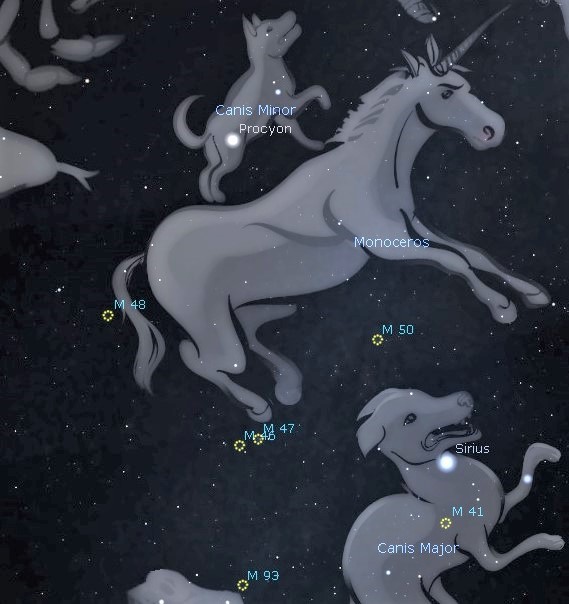
Monoceros is a constellation that is easy to locate, sandwiched between Orion’s dogs Canis Major and Canis Minor, but it is not easy to see. From urban areas its dim stars are as elusive as the unicorn they depict. It was one of eight new constellations created on a globe by the Dutch cartographer Petrus Plancius around 1612. Of those eight, only Monoceros and Camelopardalis are recognized as official constellations today. Monoceros is situated within the winter Milky Way, which is apparent in rural skies.
Despite being a dim constellation, Monoceros is home to some favourite targets of astrophotographers, in particular the beautiful Rosette Nebula. Another is the combination of the Cone Nebula, Christmas Tree Cluster and the Fox Fur Nebula. Check the Internet for their stunning images. Monoceros has one Messier object within its boundary, the large open cluster M50, otherwise known as the Heart-Shaped Cluster. It can be seen in binoculars about 40% of the distance from Sirius to Procyon. Three other open clusters on the Messier list are found near Monoceros but they lie officially within other constellations. They are the close pair of M46 and M47 in Puppis, and M48 in Hydra.
This Week in the Solar System
Saturday’s sunrise is at 7:58 and sunset will occur at 5:10, giving 9 hours, 12 minutes of daylight. Next Saturday the Sun will rise at 7:52 and set at 5:20, giving 9 hours, 28 minutes of daylight.
The Moon is new on Sunday and it passes above Saturn next Friday. Saturn is fairly high in the southwest in early evening, setting around 10 pm. Jupiter is at its highest by 11:30. On Wednesday telescope users might see Jupiter’s moon Io lead its shadow across the planet between 7:50 and 10:20, at which time the Red Spot will be midway across the planet. Venus, Mars and Mercury are out of sight, with Mercury at superior conjunction on Wednesday.
Tune in to the Sunday Night Astronomy Show at 8 pm on the YouTube channel and Facebook page of Astronomy by the Bay.
Questions? Contact Curt Nason at nasonc@nbnet.nb.ca.