
This Week’s Sky at a Glance, 2026 Jan 31 – Feb 7
This Week’s Sky at a Glance, 2026 Jan 31 – Feb 7
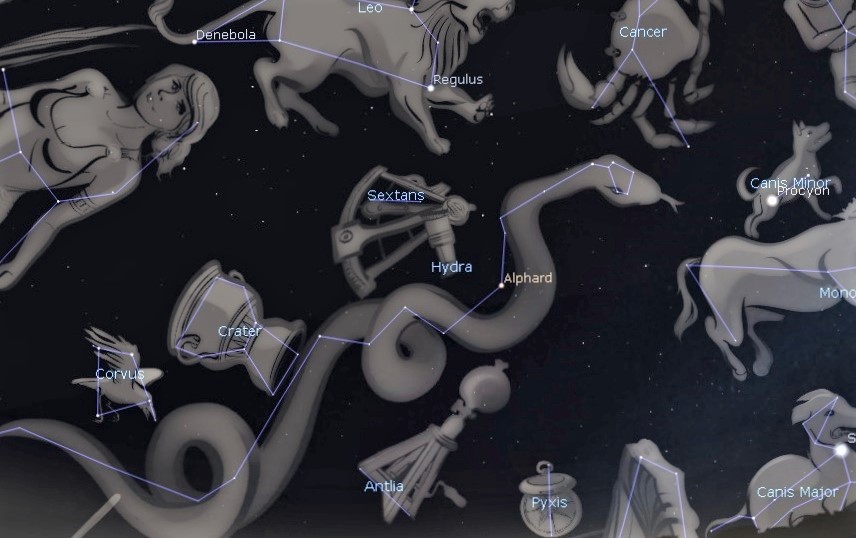
The constellation Hydra is the largest of the 88 and it represents a female water snake. I mention the gender because there is a male water snake constellation, Hydrus, in the southern hemisphere. A small trapezoid of stars, located about halfway below a line between Procyon in Canis Minor and Regulus in Leo, represents the snake’s head. To its lower left is a solitary bright star called Alphard, the heart of the snake. The rest of the constellation is a long serpentine string of fainter stars that stretches to Virgo. It takes about eight hours for the entire constellation to rise. Two other constellations, Corvus the Crow and Crater the Cup, are sitting on Hydra’s back.
In mythology, Hercules had to kill the multi-headed Hydra as the second of his famous labours. Knowing the creature could only be killed by severing all of the heads, and that two would grow in where one was severed, he placed a tree stump in a fire. When he cut off a head he cauterized the wound with the glowing stump to prevent regrowth. When Hera saw that Hercules might win she sent a crab to distract him, but he easily stomped it dead. That explains the presence of the dim constellation Cancer the Crab just above the head of Hydra. Hera despised Hercules because he was the illegitimate son (one of many) of her husband Zeus. When the Hydra was slain, Hercules dipped his arrows in the Hydra’s poisonous blood for later use.
This Week in the Solar System
Saturday’s sunrise in Moncton is at 7:42 and sunset will occur at 5:22, giving 9 hours, 40 minutes of daylight (7:45 and 5:30 in Saint John). Next Saturday the Sun will rise at 7:33 and set at 5:33, giving 10 hours of daylight (7:36 and 5:40 in Saint John).
The Moon is full on Sunday and just before 10 pm Monday it passes in front of the bright star Regulus for about an hour. Saturn is in the southwest in evening twilight this week, setting soon after 9 pm. Jupiter is at its highest around 10:30, and on Tuesday telescope users might see its moon Europa reappear from eclipse at 6:43 and Callisto disappear behind the planet at 10:35. By midweek binocular users might pick out Venus setting half an hour after sunset with Mercury within the view to its upper left. Mars is out of sight on the far side if the Sun. Also starting midweek rural observers might catch the zodiacal light angling up the ecliptic 60 to 90 minutes after sunset.
Tune in to the Sunday Night Astronomy Show at 8 pm on the YouTube channel and Facebook page of Astronomy by the Bay. The Saint John Astronomy Club meets in the Rockwood Park Interpretation Centre on February 7 at 7 pm.
Questions? Contact Curt Nason at nasonc@nbnet.nb.ca.