
This Week’s Sky at a Glance, 2026 June 20 – June 27
This Week’s Sky at a Glance, 2026 June 20 – June 27
Seasons are the result of the earth’s rotational axis being tilted about 23.5 degrees off the vertical with respect to its orbit. The first day of astronomical summer is this Sunday. The “astronomical” qualification is used because meteorologists have taken to confusing people with meteorological seasons based on temperatures. Meteorological summer in the northern hemisphere includes June, July and August because they have the highest average temperatures for the year.
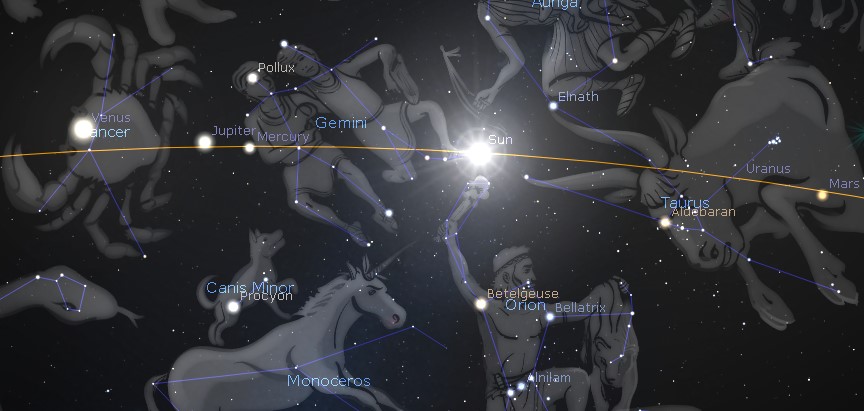
On the summer solstice, the Sun rises and sets at its most northerly points on the horizon. For those of us at 45 degrees latitude, at midday (1:21 pm in Moncton) the Sun is about 68.5 degrees above the southern horizon; its highest altitude for the year. If we lived at latitude 23.5 degrees the Sun would be directly overhead at midday on the solstice. Several millennia ago the Sun was “in” the constellation Cancer on the solstice, hence that latitude is marked on maps as the Tropic of Cancer. The dim constellation does resemble a crab somewhat, but there is speculation that the Sun’s forth and back movement along the horizon at that time of year was reminiscent of a crab’s sideways walk.
The summer solstice point on the ecliptic, the Sun’s path through the constellations, has since passed through Gemini into Taurus. The roaming solstice is due to Earth’s axis wobbling like a top, making one revolution every 25,800 years in what we call the precession of the equinoxes. Enjoy your summer, whenever it starts.
This Week in the Solar System
Saturday’s sunrise in Saint John is at 5:36 and sunset will occur at 9:15, giving 15 hours, 39 minutes of daylight. Next Saturday the Sun will rise at 5:38 and set at 9:16, giving 15 hours, 38 minutes of daylight. The Sun reaches its most northern point of the ecliptic, the summer solstice, this Sunday morning at 5:25.
The Moon is at first quarter on Sunday and on June 27 it is near the orange supergiant star Antares in Scorpius. The alignment of evening planets changes over the week as dim Mercury moves below the ecliptic, By midweek it sets around 10:30, followed by Jupiter 20 minutes later, and Venus 50 minutes after that. Early in the week Saturn rises around 2 am and Mars an hour and a half later.
Tune in to the Sunday Night Astronomy Show at 8 pm on the YouTube channel and Facebook page of Astronomy by the Bay.