
This Week’s Sky at a Glance, 2026 June 6 – June 13
This Week’s Sky at a Glance, 2026 June 6 – June 13
Globular clusters are among the oldest and largest objects associated with our galaxy, with some being about 12 billion years old and containing tens to hundreds of thousands of stars packed into a compact sphere. There are more than 150 globulars orbiting in the halo of the Milky Way galaxy, and many more are known to be orbiting larger galaxies like M31 in Andromeda. Many can be seen in binoculars as a fuzzy patch of light, perhaps resembling those little white patches you see below bird feeders. A medium size telescope is able to resolve some of their stars. The larger globulars as seen from a dark location have been described as looking like granules of sugar against black velvet.
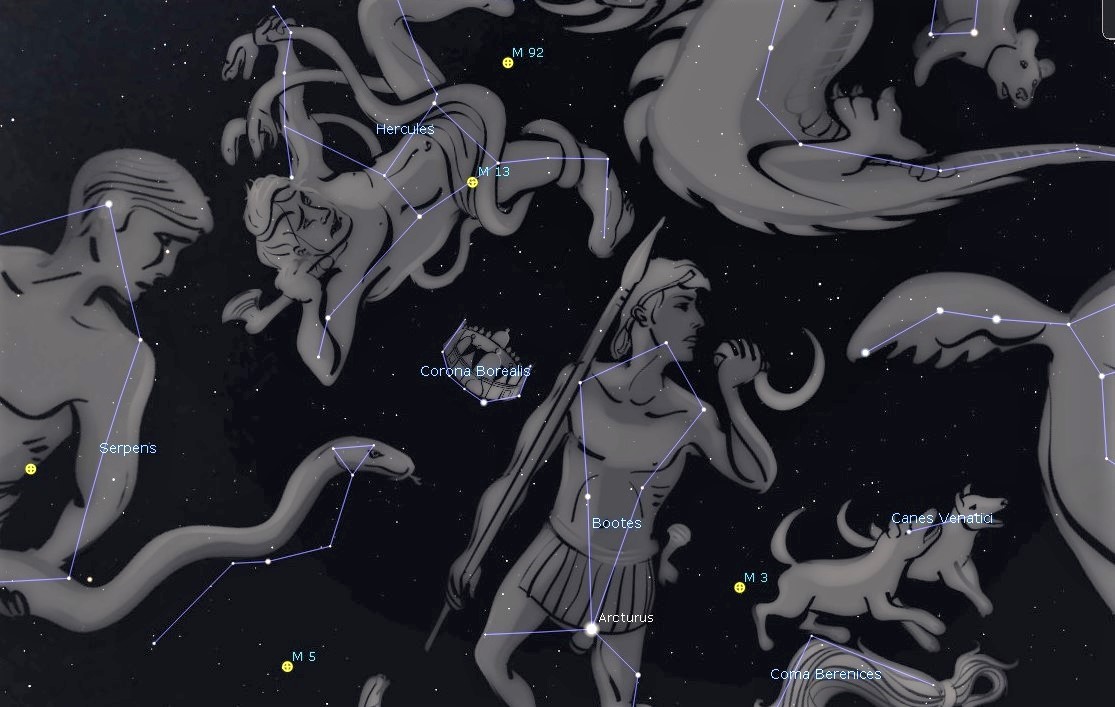
Summer is the season for observing globular clusters. M4 is just to the right of Antares in the constellation Scorpius and it is one of the closest globulars at 7000 light years. M13 in the Keystone of Hercules is relatively close at 25,000 light years. One that would outshine M13 if it were higher in our sky is M22, just left of the lid of the Teapot in Sagittarius. Another easy target is M3, located halfway between Arcturus and Cor Caroli, the brightest star in the small constellation Canes Venatici below the handle of the Big Dipper. Two other standouts are M92 in Hercules and M5 in Serpens.
From a dark sky, many dimmer globulars can be picked out in the region of Sagittarius and Ophiuchus. The concentration of globular clusters in this region of sky is not by accident, and it played a role in another lesson of humility for humanity. Harvard’s Harlow Shapley studied globular clusters a century ago and noticed that most were located around Sagittarius. If they were evenly distributed around the core of our galaxy, as believed, then the centre of the galaxy must lie in that direction. Just as Copernicus and Galileo demoted Earth from the centre of the solar system, Shapley showed that the Sun was not at the centre of the Milky Way.
This Week in the Solar System
Saturday’s sunrise in Moncton is at 5:29 and sunset will occur at 9:06, giving 15 hours, 37 minutes of daylight (5:37 and 9:08 in Saint John). Next Saturday the Sun will rise at 5:27 and set at 9:11, giving 15 hours, 44 minutes of daylight (5:35 and 9:12 in Saint John).
The Moon is at third quarter on Monday, rising at 1:36 am and setting at 1:26 pm. It is above Saturn Wednesday morning and Mars on Friday. A scenic conjunction of the two brightest planets is underway as Venus slides over Jupiter early in the week, coming as close as three Moon-widths. (Actually, Jupiter is nearly five times farther from us than is Venus.) They remain within a binocular view all week. Mercury moves to with a fist-width of Jupiter by the end of the week. On Tuesday telescope users might see the shadow of Jupiter’s moon Callisto join that of Europa on the planet’s atmosphere at 10:24 pm, a double shadow transit lasting until after Jupiter sets.
The Saint John Astronomy Club meets in the Rockwood Park Interpretation Centre this Saturday at 7 pm. Tune in to the Sunday Night Astronomy Show at 8 pm on the YouTube channel and Facebook page of Astronomy by the Bay. The Fredericton Astronomy Club meets in the UNB Forestry-Earth Sciences building on Tuesday at 7 pm.