
This Week’s Sky at a Glance, 2026 July 25 – August 1
This Week’s Sky at a Glance, 2026 July 25 – August 1
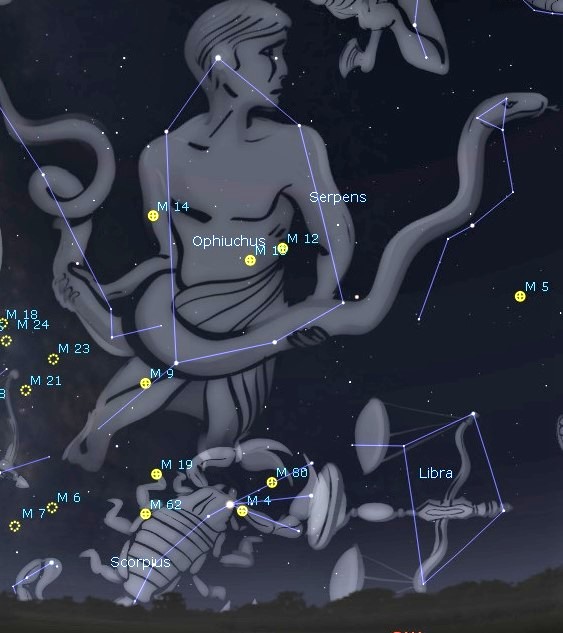
After twilight look low in the south for orange Antares in the heart of Scorpius. High above the scorpion is a large house-shaped constellation called Ophiuchus the Serpent Bearer. If your area isn’t light polluted you can see two lines of stars rising up and outward from the bottom of the house. The line on the right is Serpens Caput and the one on the left is Serpens Cauda. Together they comprise Serpens the Serpent, the only constellation that is in separate parts. Globular clusters contain many tens of thousands of stars and they orbit the centre of our galaxy, which is in the direction just above the spout of the Sagittarius Teapot asterism. Therefore, these clusters abound in the Sagittarius-Scorpius-Ophiuchus region of our sky and many can be seen in binoculars as fat, fuzzy stars.
Ophiuchus represents Asclepius from mythology, who became interested in the healing arts after killing a snake and watching another snake bring it back to life with a leaf. Asclepius brought many people back from the dead, including Orion after he was killed by the scorpion. Hades, god of the Underworld, complained to brother Zeus about a decrease in business so Zeus sent his pet eagle to kill Asclepius with a thunderbolt. The constellation of Aquila the Eagle is east of Serpens Cauda.
This Week in the Solar System
Saturday’s sunrise in Moncton is at 5:53 and sunset will occur at 8:57, giving 15 hours, 4 minutes of daylight (6:01 and 8:59 in Saint John). Next Saturday the Sun will rise at 6:01 and set at 8:48, giving 14 hours, 47 minutes of daylight (6:08 and 8:51 in Saint John).
The Moon is full on Wednesday, also known as the Thunder Moon or the Birds Shed Feathers Moon. Venus glistens through evening twilight low in the west, setting less than two hours after sunset. Saturn now rises before midnight and early in the week it begins four and a half months of retrograde (westward) motion against the stars. By 5 am this weekend Mars is fairly high in the east with similarly-hued Aldebaran to its right and Mercury rolling out of bed to its lower left. Jupiter is in conjunction with the Sun on Wednesday. Also on Wednesday morning is the peak of the South Delta Aquariid meteor shower, with shooting stars emanating from the south and the Moon setting around 4:30.
The Saint John Astronomy Club meets in the Rockwood Park Interpretation Centre on August 1 at 7 pm. The next RASC NB star party takes place at Mount Carleton Provincial Park on August 14-15.