
This Week’s Sky at a Glance, 2026 October 31 – November 7
This Week’s Sky at a Glance, 2026 October 31 – November 7
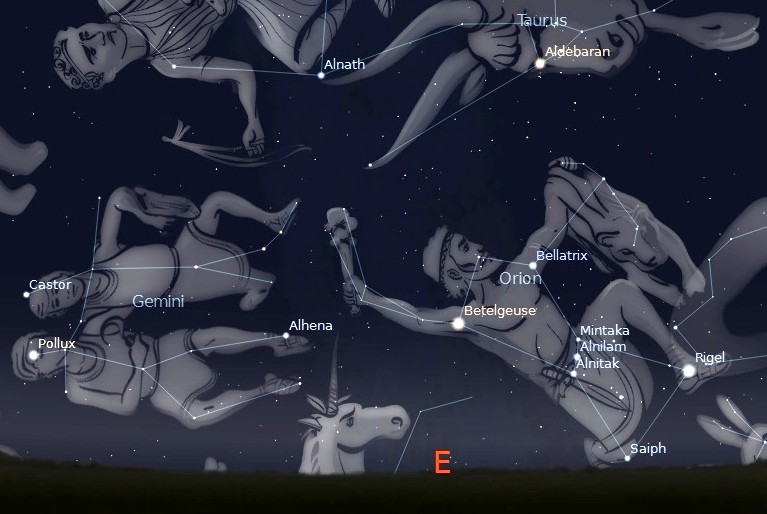
Orion can be seen getting out of bed around 8 pm now, preparing for a night of hunting. Being a giant and very old, it takes an hour and a half for his hourglass shape to clear the horizon. He rises on his side and stands upright when he is in the south. The celestial equator, an imaginary line in the sky directly above our equator, runs very near Mintaka, the star at the right of Orion’s Belt. Therefore, Mintaka rises due east. Notice how huge Orion appears as he rises, bigger than he appears a few hours later in the southeast. This is the same optical illusion that makes the Moon appear larger when it is rising or setting. The twins Castor and Pollux of the constellation Gemini rise on their side at the same time as Orion, just to his left.
If you are into genealogy, Orion, as a son of Poseidon, was a cousin to Pollux, a son of Zeus. Castor had the same mother as Pollux but a mortal father, King Tyndareus of Sparta. Even stranger, Perseus was the great-grandfather of his half-brother Heracles (Hercules to the Romans); thanks to randy old Zeus. Genealogy is more complicated when immortals are involved.
This Week in the Solar System
Saturday’s sunrise in Saint John is at 8:01 and sunset will occur at 6:13, giving 10 hours 12 minutes of daylight. Next Saturday the Sun will rise at 7:11 and set at 5:03, giving 9 hours, 52 minutes of daylight. We return to Standard Time at 2 am Sunday.
The Moon is at third quarter on Sunday, near Mars Monday and Regulus Tuesday. Over the next few mornings it anchors a lengthening line leading up through Regulus, Jupiter and Mars, and next Saturday the slim crescent makes a binocular trio with Venus and Spica. Mercury is at inferior conjunction on Wednesday and by the following week it will be replacing the Moon in the morning conga line. Saturn is well-placed for evening telescope observing, reaching its highest around 10 pm this week. The South Taurid meteor shower peaks on Thursday, adding a few extra shootings stars that morning and Friday.
Tune in to the Sunday Night Astronomy Show at 8 pm on the Facebook page or YouTube site of Astronomy by the Bay. The Saint John Astronomy Club meets in the Rockwood Park Interpretation Centre on November 7 at 7 pm.