
This Week’s Sky at a Glance, 2026 October 24 – October 31
This Week’s Sky at a Glance, 2026 October 24 – October 31
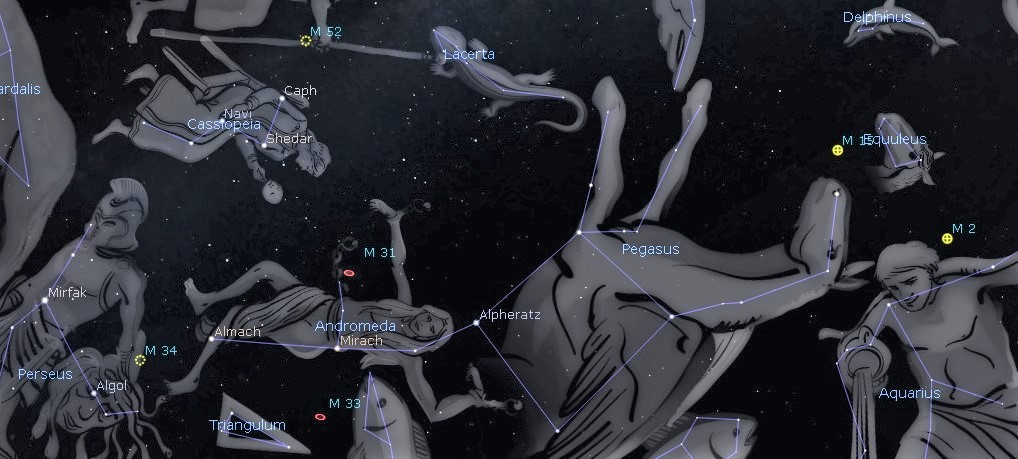
Deep sky objects (DSOs), composed of star clusters and nebulae, are often called faint fuzzies by amateur astronomers but many are bright enough to be seen with binoculars in a dark sky. Let us start by using the Square of Pegasus as a guidepost. The southwest corner of the square is the base of the winged horse’s neck, and moving away from the square by a few stars takes us to the horse’s eye. Extending that line by half its distance is where you will find a small blurry patch called M2, a globular cluster that is the second entry in the Messier list of DSOs. Angling to the left at the eye we come to a star at the horse’s snout, and extending by nearly half that distance is a larger globular cluster, M15.
The star at the northeast corner of the square is Alpheratz, the brightest star of Andromeda, from which spread two lines of stars. The second star from Alpheratz along the brighter string is orange Mirach, and moving up two stars across the dimmer string we encounter the large Andromeda Galaxy, M31. In the opposite direction from Mirach, and at about the same distance as M31, is fainter M33, the third largest galaxy in our Local Group behind Andromeda and the Milky Way. We see M33 face on, which makes it appear dimmer.
The third brightest star of Andromeda is Almach, situated at the end of the string from Mirach. Look to the right of the line more than halfway between Almach and Algol, the second brightest star in Perseus, for the open cluster of stars called M34. Next, look above Andromeda for the familiar W-shape of Cassiopeia. A line from the bottom right star of the W to the top right and extended the same distance brings us to open cluster M52.
This Week in the Solar System
Saturday’s sunrise in Moncton is at 7:48 and sunset will occur at 6:17, giving 10 hours, 29 minutes of daylight (7:52 and 6:23 in Saint John). Next Saturday the Sun will rise at 7:58 and set at 6:06, giving 10 hours, 8 minutes of daylight (8:01 and 6:13 in Saint John).
The full Hunter’s Moon occurs on Monday, and when it rises around 7 pm on Tuesday it will be starting to pass in front of the Pleiades star cluster. Over the evening use binoculars or a telescope to watch stars disappear behind the sunlit lunar rim and reappear on the slightly unlit side an hour later. I have heard many excited comments about the beauty of Saturn and its rings during public outreach events this past week. It is well-placed for evening telescope observing, reaching its highest around 11:30 this week. Mars, Jupiter and Regulus make an ever-decreasing line high in the southeast before morning twilight, while the bright stars of the Winter Circlet shine in the southern sky. Mercury and Venus are too close to the Sun to be seen this week.
Tune in to the Sunday Night Astronomy Show at 8 pm on the Facebook page or YouTube site of Astronomy by the Bay.