
This Week’s Sky at a Glance, 2026 July 4 – July 11
This Week’s Sky at a Glance, 2026 July 4 – July 11
Galaxies are favourite targets for amateur astronomers and many are visible with just binoculars. Two are seen easily with the naked eye in the southern hemisphere: the Large and Small Magellanic Clouds. The Andromeda Galaxy is a naked-eye blur for rural New Brunswickers and it looks majestic in binoculars, but there is one galaxy that is spectacular from a reasonably dark location regardless of your observing equipment and that is our home galaxy.
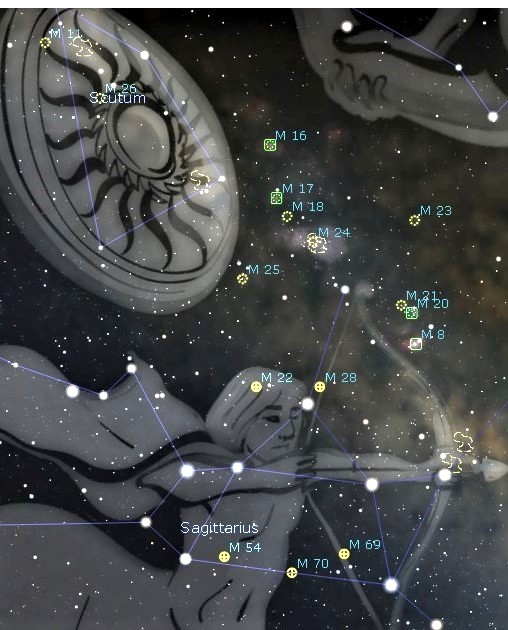
The Milky Way is at least 110,000 light years across, and although it is composed of perhaps 400 billion stars we can distinguish only about 4000 unaided as individual stars from a rural area. The Sun is 27,000 light years from the galactic core, within a spur between the inner Sagittarius and outer Perseus spiral arms. When we look above the spout of the Sagittarius Teapot asterism we are looking toward the galactic core, but vast clouds of dust hide the stars between the spiral arm and the core. South of the head of Cygnus the Swan we see the Milky Way split in two by the Great Rift, one of those dust clouds.
Star formation occurs in clouds of gas and dust within the spiral arms and some can be seen as bright patches with binoculars. Just above the spout of the Teapot is M8, the Lagoon Nebula; and a hint of M20, the Trifid Nebula, can be seen in the same field of view above. Scanning to the upper left up the Milky Way you encounter M17, the Swan (or Omega) Nebula; and star clusters M16 in the Eagle Nebula and M11, the Wild Duck Cluster. A tour of the Milky Way under a dark sky can keep a binocular stargazer engaged for an evening.
This Week in the Solar System
Saturday’s sunrise in Saint John is at 5:41 and sunset will occur at 9:14, giving 15 hours, 33 minutes of daylight. Next Saturday the Sun will rise at 5:47 and set at 9:11, giving 15 hours, 24 minutes of daylight. Earth is at aphelion, its farthest distance from the Sun, on Monday afternoon.
The Moon is at third quarter and above Saturn on Tuesday, and it visits the Pleiades and Mars next Saturday. This Saturday morning Mars is a third of a moon-width below Uranus. Venus is within a binocular view of Regulus all week, passing just above that star on Thursday. Jupiter is low in the northwest in evening twilight, while Mercury is too close to the Sun for observing.
The Saint John Astronomy Club meets in the Rockwood Park Interpretation Centre this Saturday at 7 pm.