
This Week’s Sky at a Glance, 2026 June 27 – July 4
This Week’s Sky at a Glance, 2026 June 27 – July 4
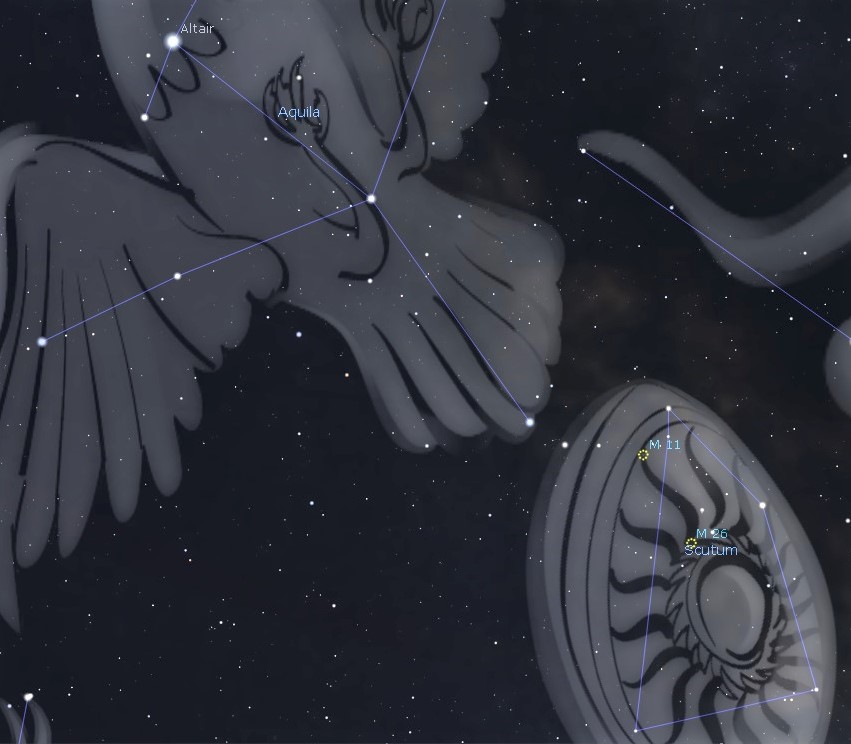
Sagittarius is an old constellation of a centaur with a bow and arrow aiming toward Scorpius the Scorpion. If he tries to shoot Aquila the Eagle above, chances are the arrow will be deflected by a shield.
Scutum the Shield is a relatively new constellation, created by the Polish astronomer Johannes Hevelius in the late 17th century. It commemorates the Polish king John Sobieski III, who defended his country against the Turks. Originally named Scutum Sobiescianum (Sobieski’s Shield) it is generally just called the Shield. Seeing it can be difficult, for its main stars are dim and shielded within the Milky Way. One way to locate it is to find its most prominent deep sky object, the Wild Duck Cluster or M11.
Find the bright star Altair in the head of Aquila and then identify the wings and tail of the eagle. Binoculars will reveal a string of stars leading from the tail to M11 at the top of the shield. The rich Wild Duck Cluster looks good in binoculars and great in a scope, and an imaginative observer can see a V-shape or maybe two. Star cluster M26 is also in Scutum, a binocular width south of M11.
This Week in the Solar System
Saturday’s sunrise in Moncton is at 5:30 and sunset will occur at 9:14, giving 15 hours, 44 minutes of daylight (5:38 and 9:16 in Saint John). Next Saturday the Sun will rise at 5:33 and set at 9:13, giving 15 hours, 40 minutes of daylight (5:41 and 9:14 in Saint John).
The Moon is near the orange supergiant star Antares in Scorpius on Saturday and it is full on Monday. With Mercury and then Jupiter setting in late twilight Venus rules the western sky, setting around 11:30 this weekend. It inches toward Regulus over the week, a prelude to a close conjunction on July 9. Saturn is high in the south-southeast by the onset of morning twilight, but Mars steals the morning show this week. It moves to within a wide binocular view below the Pleiades, and on the morning of July 4 it is a third of a Moon-width below Uranus with a star between them. Uranus can be seen with binoculars.
Tune in to the Sunday Night Astronomy Show at 8 pm on the YouTube channel and Facebook page of Astronomy by the Bay; the last show until mid-September. Reruns are available on YouTube, The Saint John Astronomy Club meets in the Rockwood Park Interpretation Centre on July 4 at 7 pm.