
This Week’s Sky at a Glance, 2026 August 22 – August 29
This Week’s Sky at a Glance, 2026 August 22 – August 29
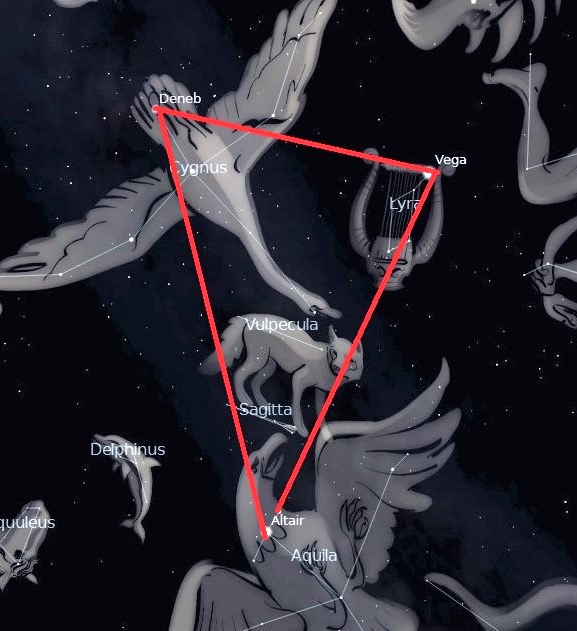
The Summer Triangle is at its highest in early evening. Vega pokes through the twilight overhead, followed by Altair to the south and Deneb to the east. All three are the brightest stars of their respective constellations of Lyra, Aquila and Cygnus. Although it is the dimmest of the trio, Deneb is actually much brighter but it is about 60 times more distant. If it were as close as the other two it would be more than ten times brighter than Venus.
The brighter stars appear near the end of civil twilight, when the Sun reaches six degrees below the horizon. Nautical twilight ends when it is 12 degrees below, at which time mariners have difficulty discerning the distant coastline from water. Readings for celestial navigation were taken during nautical twilight. When the Sun is 18 degrees below the horizon astronomical twilight ends, and in areas with no light pollution or moonlight the only light is from stars, planets, and airglow. Around the summer solstice northern New Brunswick gets only 80 minutes of dark sky between the end and start of astronomical twilight, while southern New Brunswick gets 3 hours and 10 minutes.
This Week in the Solar System
Saturday’s sunrise in Saint John is at 6:33 and sunset will occur at 8:19, giving 13 hours, 46 minutes of daylight. Next Saturday the Sun will rise at 6:42 and set at 8:07, giving 13 hours, 25 minutes of daylight.
The Moon is full and in eclipse overnight Thursday/Friday, a deep partial eclipse (93% of the diameter) between 11:33 pm and 2:52 am. Jupiter rises at 5 am this weekend, at which time Mars is three fist-widths above the eastern horizon and Saturn is halfway up the south-southwestern sky. Venus is low in the west-southwest at sunset, and Mercury is lost to view as it reaches superior conjunction on Thursday.
The next RASC NB star party will be on September 4-5 at Fundy National Park.