
This Week’s Sky at a Glance, 2026 August 29 – September 5
This Week’s Sky at a Glance, 2026 August 29 – September 5
Technically, any three stars in the sky will form some sort of a triangle, but there are those that stand out. Overhead in early evening is the best known celestial threesome, the isosceles Summer Triangle of Vega, Deneb and Altair. Straddling the Milky Way, each star is the brightest in their respective constellations of Lyra the Harp, Cygnus the Swan and Aquila the Eagle. An ancient tale of Eastern mythology depicted Vega and Altair as lovers separated by a river (the Milky Way). I look at them as an updated version of that tale, that of Running Bear and White Dove in the Johnny Preston hit written by the Big Bopper, J.P. Richardson.
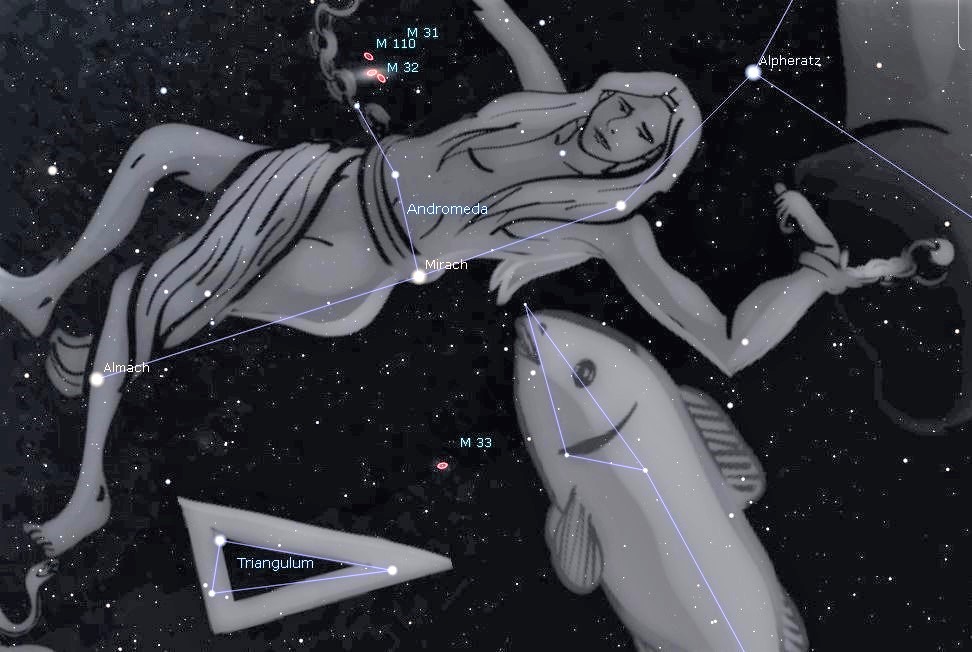
With the Summer Triangle overhead, the constellation Triangulum the Triangle is low in the east below Andromeda. Known as a constellation for thousands of years, it has been said to represent, among other things, the Nile Delta and the island of Sicily. If you have a dark sky, use binoculars to look about a third of the way and a tad to the right, between the tip of Triangulum and the orange star Mirach in Andromeda above, to see the face-on spiral galaxy M33.
Now that summer is fading, and if you can’t wait for winter, just look to the east in morning darkness for the Winter Triangle. Orange Betelgeuse in Orion’s armpit joins with Orion’s companion Dog Stars of Sirius and Procyon to form an equilateral triangle. All three stars make the top ten in brightness.
This Week in the Solar System
Saturday’s sunrise in Saint John is at 6:42 and sunset will occur at 8:07, giving 13 hours, 25 minutes of daylight. Next Saturday the Sun will rise at 6:50 and set at 7:54, giving 13 hours, 4 minutes of daylight.
The Moon is near the Pleiades Thursday morning and it is at third quarter the following day. Venus and Spica will be a binocular couple low in the west-southwest a half hour after sunset this week, with Venus just below it on Tuesday. Saturn will be on the rise around the time they set. An hour before sunrise Jupiter is a fist-width above the eastern horizon with Sirius, the brightest star of the night sky, equally high in the southeast. Reddish-orange Mars will be much higher and a little to the right of Jupiter, with similarly coloured Betelgeuse as high above Sirius. Mercury has moved to the evening sky but it will be lost in twilight for a couple of weeks, and even then it will be a difficult target.
The RASC NB Fundy Park Stargaze will be on September 4-5 at Fundy National Park. On the following weekend Mount Carleton Provincial Park will host a special astronomy-themed Dark Sky Experience weekend. The next meeting of the Saint John Astronomy Club will be on September 12.