
This Week’s Sky at a Glance, 2026 Feb 7 – Feb 14
This Week’s Sky at a Glance, 2026 Feb 7 – Feb 14
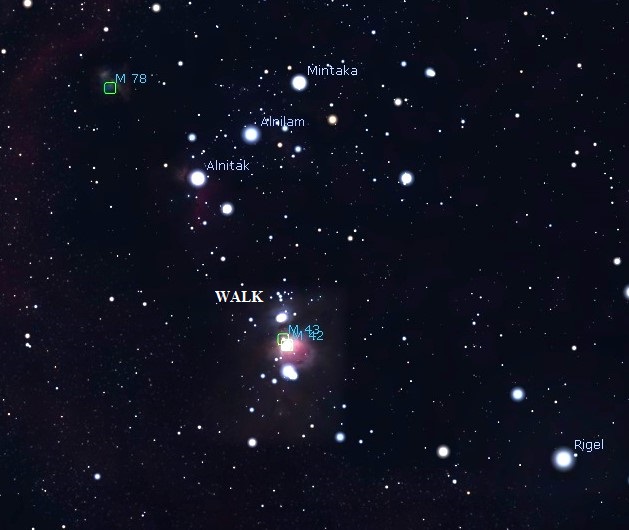
Binoculars are great instruments for observing the brighter star clusters and nebulae in the night sky, and Orion is a great place for binocular treasures. Its most prominent naked eye feature is the angled line of three stars that make Orion’s Belt. This trio, part of a star cluster called Collinder 70, will fit easily within almost any binocular view. They are hot giant stars with the one on the right, Mintaka, being a little dimmer than Alnitak on the left and Alnilam in between. Although they appear to be near each other, at a distance of 2000 light years Alnilam is nearly three times farther than the other two. Between Alnilam and Mintaka binoculars will show an S-shaped asterism, Orion’s S, which peaks above his belt.
Below the belt is a string of a few dimmer stars that makes Orion’s sword, one of which looks fuzzy to the eye. Binoculars reveal this to be the Orion Nebula or M42, a vast cloud of gas and dust where stars are forming. Just above the nebula is an asterism that resembles a person running or perhaps the figure in a WALK sign. Several double or multiple stars can be seen in this general area. Binoculars will also enhance star colours so check out Orion’s two brightest stars, blue-white Rigel and orange Betelgeuse. Defocusing your binoculars slightly will enhance the colours even more.
This Week in the Solar System
Saturday’s sunrise in Moncton is at 7:33 and sunset will occur at 5:33, giving 10 hours of daylight (7:36 and 5:40 in Saint John). Next Saturday the Sun will rise at 7:23 and set at 5:43, giving 10 hours, 20 minutes of daylight (7:26 and 5:50 in Saint John).
The Moon is at third quarter on Monday and near Antares Wednesday morning. Mercury and Venus have joined Saturn in the west in evening twilight. The increasing angle of the ecliptic makes this the best evening apparition of the year for Mercury, although it will be dimming rapidly toward the end of the month. Midweek Venus sets 40 minutes after sunset and Mercury will be about a binocular width to its upper left. Jupiter will be high overhead around 10 pm, and on Wednesday telescope users can see its moon Ganymede emerge from transit at 6:12 while its shadow begins a leisurely three hour transit. Rural observers might catch the zodiacal light angling up the ecliptic 60 to 90 minutes after sunset.
The Saint John Astronomy Club meets in the Rockwood Park Interpretation Centre this Saturday at 7 pm. Tune in to the Sunday Night Astronomy Show at 8 pm on the YouTube channel and Facebook page of Astronomy by the Bay. The Fredericton Astronomy Club meets in the UNB Forestry-Earth Sciences building on Tuesday at 7 pm.
Weekly Sky at a Glance ~by Curt Nason