
This Week’s Sky at a Glance, 2026 March 7 – March 14
This Week’s Sky at a Glance, 2026 March 7 – March 14
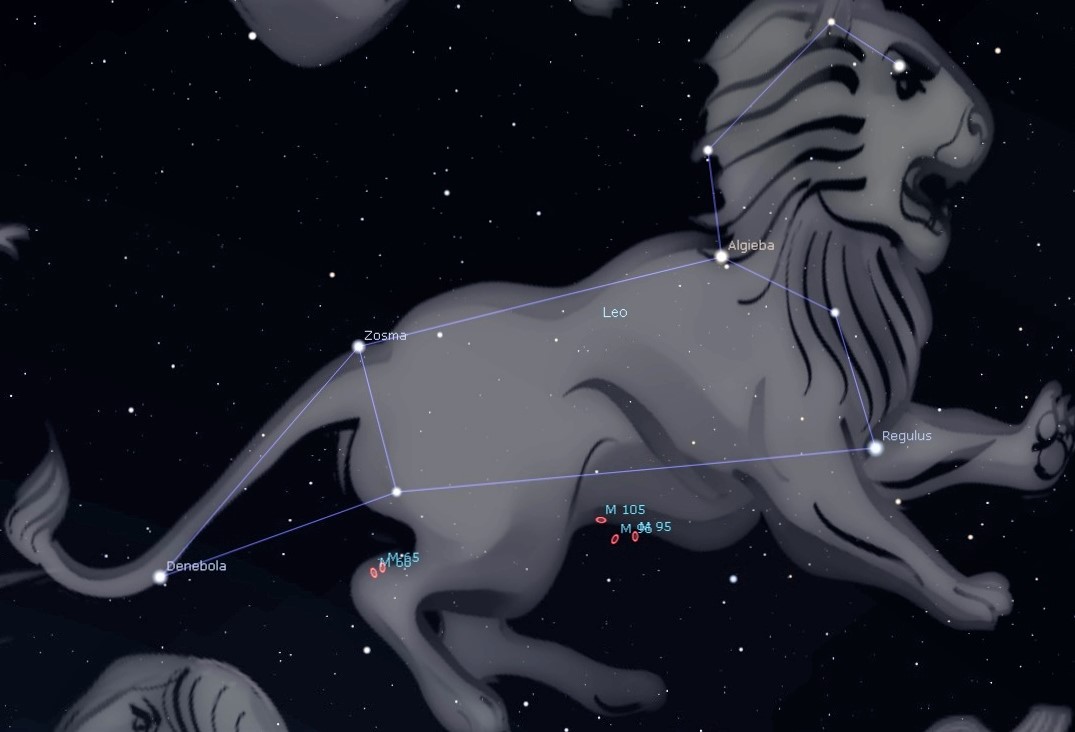
I regard Leo the Lion as the signature constellation of spring, and it is not difficult to picture a lion in its distinctive pair of asterisms. A backwards question mark or a sickle represents its chest and mane, anchored by the bright star Regulus at its heart or front leg. To the east a triangle of stars forms the back leg and tail. Originally, a faint naked-eye cluster of stars represented a tuft at the end of the tail, but that now makes the tresses of the constellation Coma Berenices.
In mythology the lion was a vicious creature that resided in the mountains of Nemea. Its hide was impenetrable to spears or arrows; the only thing sharp enough to penetrate the lion’s hide was its claws. The first of Hercules’s twelve Labours was to kill this creature, which the legendary strongman did by strangulation. He then used the claws to cut off the lion’s hide for use as a shield. A friend of mine sees this constellation as a mouse, with the triangle as its head and the sickle as its tail. However, legends are not made by having a muscular demigod battle a mouse.
This Week in the Solar System
Saturday’s sunrise in Moncton is at 6:46 and sunset will occur at 6:14, giving 11 hours, 28 minutes of daylight (6:51 and 6:19 in Saint John). Next Saturday the Sun will rise at 7:33 and set at 7:23, giving 11 hours, 50 minutes of daylight (7:38 and 7:28 in Saint John). Daylight time begins this Sunday at 2 am.
The Moon is near Antares Tuesday morning and it is at third quarter Wednesday. This weekend Venus will be passing closely to the right of Saturn as they head in opposite directions. Jupiter reaches its second stationary point on Tuesday, after which it resumes eastward motion relative to the stars. On Monday evening telescope and perhaps binocular users might see its moons Io and Callisto reappear from the planet’s shadow at 9:12 and 9:37, respectively. Mercury is at inferior conjunction this Saturday, moving into a difficult morning apparition for observing later in the month. Mars is too close to the Sun for viewing. Rural observers might see the subtle wedge of zodiacal light reaching toward the Pleiades 60 to 90 minutes after sunset.
The Saint John Astronomy Club meets in the Rockwood Park Interpretation Centre on March 7 at 7 pm. Tune in to the Sunday Night Astronomy Show at 8 pm on the YouTube channel and Facebook page of Astronomy by the Bay. The Fredericton Astronomy Club meets in the UNB Forestry-Earth Sciences building on Tuesday at 7pm.