
This Week’s Sky at a Glance, Dec 27 – Jan 3 2026
This Week’s Sky at a Glance, Dec 27 – Jan 3 2026
Around midnight in the first week of January the brightest star in the night sky is due south, at its highest above the horizon. Astronomers would say it is transiting the meridian when it crosses the north-south line. Many 19th century observatories, including the one now called the William Brydone Jack Observatory at UNB Fredericton, would collaborate in timing the transits of stars to determine the longitudes of their observatories.
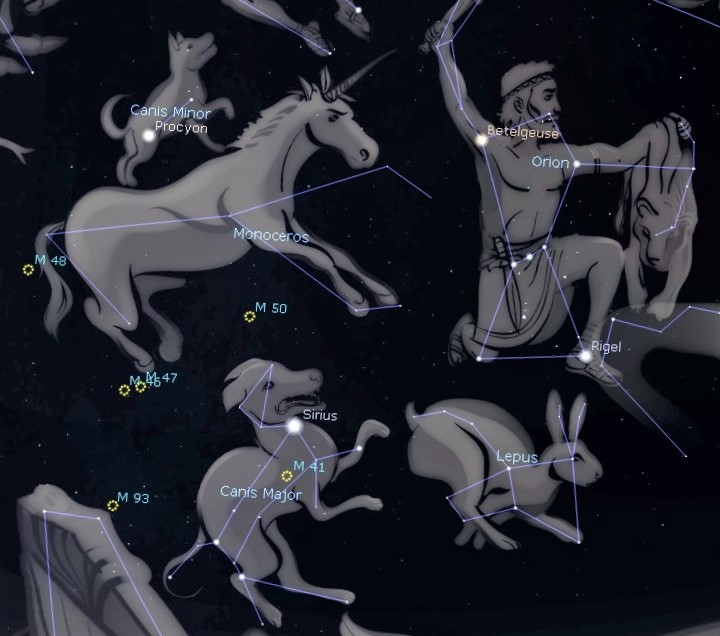
Sirius is called the Dog Star because it is part of the constellation Canis Major the Great Dog, one of Orion’s hunting companions. If you are unsure which star is Sirius, follow Orion’s Belt down to the left. The star is about twice the size of the Sun and 25 times more luminous, but that is not why it is the brightest. It is only 8.6 light years away, 82 trillion kilometres, and the nearest naked eye star for us in New Brunswick. The name means “scorcher” or “scintillating one” and it often twinkles wildly and colourfully, especially when it is lower in the sky. I like to observe it with binoculars or a telescope just to enjoy the light show. Look for the star cluster M41 about a binocular field below Sirius. With the Sun passing above Orion in summer, people once believed the hot days were due to extra heat from Sirius, hence the term “dog days of summer.”
This Week in the Solar System
Saturday’s sunrise is at 8:02 and sunset will occur at 4:48, giving 8 hours, 46 minutes of daylight. Next Saturday the Sun will rise at 8:03 and set at 4:54, giving 8 hours, 51 minutes of daylight. Earth is at perihelion early afternoon on January 3, a mere 147.1 million kilometres from the Sun.
The Moon is at first quarter this Saturday and full early next Saturday morning. On Tuesday we can watch it creeping up on the Pleiades star cluster. Mercury will be a difficult binocular object, rising about 50 to 30 minutes before sunrise over the week. Saturn sets around 11 pm this week, and Jupiter rises in evening twilight as it nears opposition on January 10. On Tuesday telescope users might see the shadow of Jupiter’s moon Ganymede crossing the planet from 6:04 to 9:20, with the moon itself trailing by about an hour. After opposition the moons will precede their shadow. The Quadrantid meteor shower peaks on January 3.
The Saint John Astronomy Club meets in the Rockwood Park Interpretation Centre on January 3 at 7 pm. The Sunday Night Astronomy Show resumes on January 4.