
This Week’s Sky at a Glance, 2026 September 19 – September 26
This Week’s Sky at a Glance, 2026 September 19 – September 26
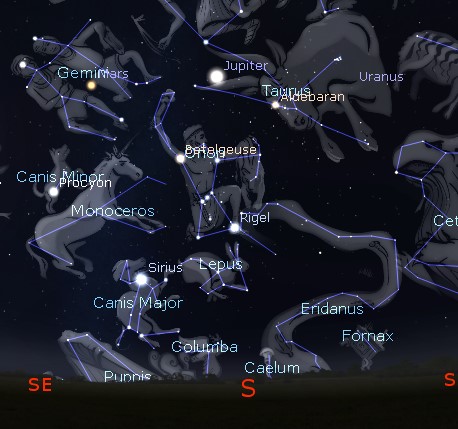
This is a good time of year to double your sky observing time. For the next several weeks, before we return to Standard Time, the sky is dark and the stars are blazing when most people are up to start their day, and it is not bitterly cold or snowbound. Orion and his dogs are prominent to the south, with Taurus, Auriga and Gemini arching over them. Sirius, Rigel, Procyon and Betelgeuse are the first, seventh, eighth and tenth brightest stars in the night sky.
In early evening you can see the 4th, 5th and 6th brightest stars. Look for yellow Arcturus sinking to the west, blue-white Vega overhead and Capella in Auriga rising in the northeast. Capella is our brightest circumpolar star; it never sets for most or all of New Brunswick. Later, notice the positions of the circumpolar Big Dipper, Little Dipper and Cassiopeia. The next morning go outside and see how they have changed. Sometimes it is nice to have a little assurance that the world keeps right on turning.
This Week in the Solar System
Saturday’s sunrise in Moncton is at 7:02 and sunset will occur at 7:22, giving 12 hours, 20 minutes of daylight (7:07 and 7:27 in Saint John). Next Saturday the Sun will rise at 7:11 and set at 7:08, giving 11 hours, 57 minutes of daylight (7:16 and 7:13 in Saint John). The Sun crosses the equator at 9:05 pm Tuesday, heading south to start the autumnal season.
The Moon is in the waxing gibbous phase all week, culminating with the full Harvest Moon next Saturday. Whereas the ecliptic makes a shallow angle with the horizon in evening this time of year, the Moon and planets are low after sunset. Mercury has a meet-up with Spica late in the week as it heads toward Venus, with both planets setting barely a half hour after sunset next weekend. Binoculars and an elevated view of a clear southwestern horizon are needed to see them. Saturn rises around 8 pm this weekend, becoming a prime evening target in telescopes. Mars lines up with Castor and Pollux in the morning sky over the week, moving toward a beautiful conjunction with Jupiter in mid-November. Try observing Jupiter with binoculars; how many of its four big moons can you see?
The RASC NB Fall Star Fest takes place September 18-19 at Kouchibouguac National Park. Tune in to the Sunday Night Astronomy Show at 8 pm on the Facebook page or YouTube site of Astronomy by the Bay.