
This Week’s Sky at a Glance, 2026 November 21 – November 28
This Week’s Sky at a Glance, 2026 November 21 – November 28
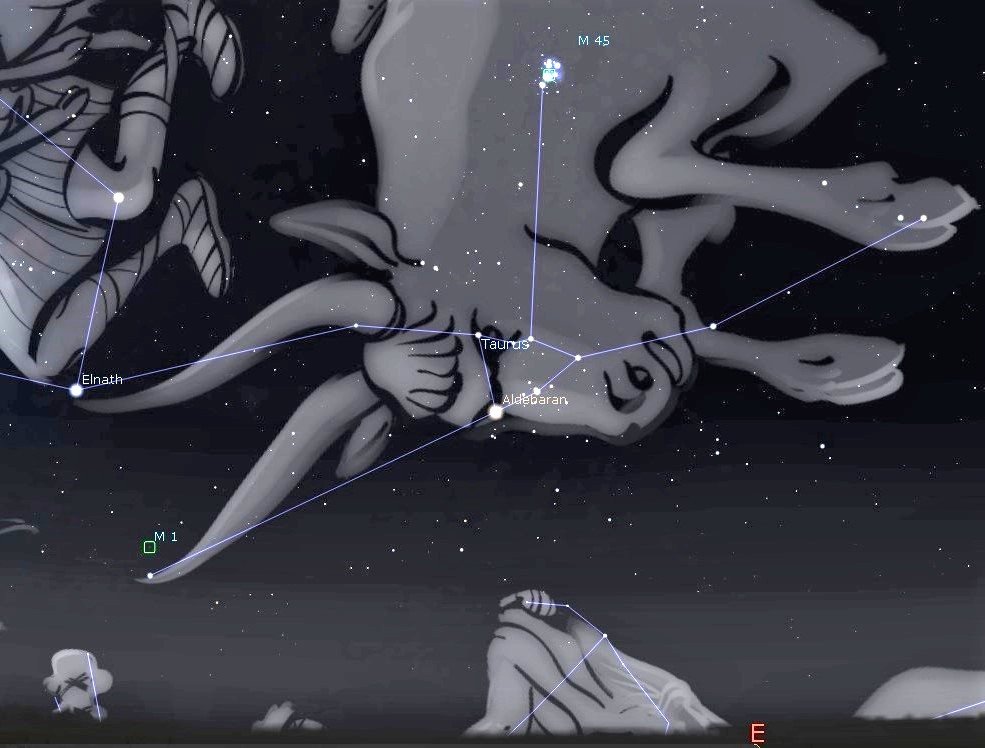
The constellation of Taurus the Bull has completely cleared the eastern horizon by 6:30 pm this week. It is distinguished by two relatively close star clusters: the compact dipper-shaped Pleiades (M45) in the bull’s shoulder and the V-shaped Hyades that forms the bull’s face. The bright orange star Aldebaran anchors one side of the V, representing the bull’s fiery eye, but it is not actually part of the cluster as it is much closer. In mythology the Pleiades (aka the Seven Sisters) and the Hyades were half-sisters; daughters of Atlas, who obviously didn’t spend all his time holding up the sky.
Starting from the apex of the Hyades, extend each side of the V outward to a star. These stars are the tips of the bull’s horns. The upper star is Elnath, which forms one of the corners of Auriga the Charioteer although it is officially part of Taurus. The other horn star has a famous dim neighbour, which is about one degree away and slightly to the right of a line joining the horns. Called the Crab Nebula or M1 for being the first entry in Charles Messier’s 18th century catalogue, this little fuzzy patch is a gaseous supernova remnant. The supernova, a death-explosion of a giant star, was seen in daylight for three weeks in 1054. I have seen M1 in a transparent sky with binoculars but a telescope gives a better view.
This Week in the Solar System
Saturday’s sunrise in Saint John is at 7:30 and sunset will occur at 4:49, giving 9 hours, 19 minutes of daylight. Next Saturday the Sun will rise at 7:39 and set at 4:44, giving 9 hours, 5 minutes of daylight.
The Moon approaches the Pleiades on Monday evening and they are close together when they set Tuesday morning. The Moon is full that morning and at perigee Wednesday so expect extreme tides midweek. Mars crosses above Regulus during the week and they fit within a 5-degree binocular view of Jupiter. Venus slides down to the left of Spica and they remain within a binocular view. Rising before 6 am most of the week and brightening slightly, Mercury should be a naked-eye object a fist-width below and left of Venus. Saturn is at its best for telescope observing around 8:30 pm. Uranus is at opposition on Wednesday, about 8 degrees east of the Pleiades. With Neptune 10 degrees west of Saturn, this is a good week to see all the planets in one day or night.
Tune in to the Sunday Night Astronomy Show at 8 pm on the YouTube channel and Facebook page of Astronomy by the Bay.